
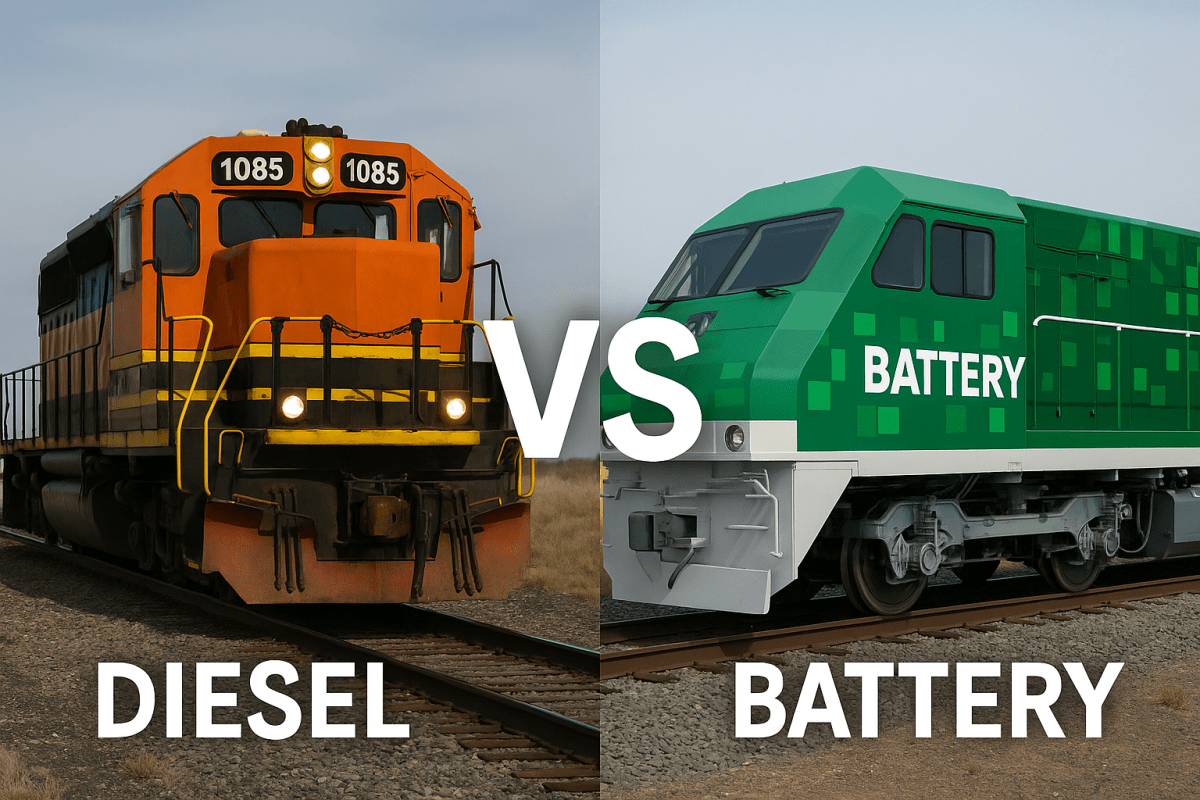
Every day, thousands of diesel locomotives thunder across America, burning through their share of 4 billion gallons of fuel annually while hauling freight over nearly 140,000 miles of track. It’s a system that’s worked reliably for more than a century. But now, a two-year-old startup called Voltify has an audacious plan that could upend everything: replacing diesel fuel with rechargeable batteries.
The $94 Billion Question
The numbers behind America’s $80 billion railroad industry tell a compelling story. The six largest Class 1 railroad companies—including giants like Union Pacific and CSX—collectively spend more than $11 billion every year just on diesel fuel. That’s $11 billion that could theoretically be redirected if batteries could do the job.
According to a 2021 study published in Nature Energy, switching to battery power could save rail freight companies $94 billion over 20 years while drastically cutting emissions. Meanwhile, the International Energy Agency warns that railroads need to slash emissions by about 5% annually through 2030 to meet global net-zero targets.
With financial pressure mounting and climate goals looming, the question isn’t whether railroads will eventually move away from diesel—it’s how quickly they can do it without breaking what already works.
Three Players, Three Different Bets
The race to electrify freight rail is heating up, but each major player is taking a different approach:
Wabtec developed the FLXdrive battery locomotive in 2019, focusing on hybrid systems that can cut diesel consumption by 30%. They’re already seeing orders from Australia, proving there’s real commercial interest.
Siemens Mobility launched its Charger B+AC battery-electric train for New York’s Metro-North Railroad. These locomotives can run up to 100 miles on battery power alone and seamlessly switch between overhead electric lines and onboard storage.
Voltify is betting on the most radical approach: retrofitting existing locomotives rather than replacing them entirely.
Voltify’s Radical Retrofit Strategy
Founded in 2023, Voltify wants to decarbonize freight rail in less than a decade without forcing railroads to scrap their existing fleets. Their solution centers on the VoltCar—massive battery packs on wheels that attach to current locomotives like additional freight cars.
But here’s where it gets interesting: instead of requiring expensive overhead electrification across entire routes, Voltify plans to build 1,400 solar-powered microgrids at strategic points across the country. Think of it as a charging station network for trains, where locomotives can quickly top off their battery cars without scheduled stops.
The system maintains diesel backup capability, so if a battery fails or a charging station goes down, trains can continue running on conventional fuel. According to their forecasting algorithm, this approach can predict power demands on every route, ensuring trains have energy when and where they need it.
If successful, Voltify projects this model could generate $10 billion in annual revenue while fundamentally changing how freight moves across America.
Why Railroad Executives Are Skeptical
“Reliability and uptime are everything in freight rail,” explains one industry veteran who asked not to be named. When a locomotive breaks down, it can cost thousands of dollars per hour in delays, missed connections, and crew overtime.
The concerns are practical and immediate:
Charging infrastructure: Building 1,400 microgrids across the country represents a massive upfront investment. What happens in remote areas where solar power is less reliable?
Winter performance: Battery capacity drops significantly in cold weather. How will that affect operations in places like North Dakota in January?
Maintenance complexity: Current diesel mechanics understand engines that haven’t fundamentally changed in decades. Battery systems, high-voltage electronics, and microgrid operations require entirely different skill sets.
Range anxiety: While Voltify’s diesel backup addresses some concerns, railroad operators want to know exactly how far these battery cars can go on a single charge, and how that compares to current diesel range.
Starting Small, Thinking Big
Voltify seems to understand these concerns. Rather than approaching major Class 1 railroads first, they’re planning demonstration projects with smaller regional operators this year, followed by a pilot with a major carrier in 2026.
“We’re not asking anyone to bet the farm on unproven technology,” a Voltify representative explained. “We’re asking them to test it on routes where the stakes are manageable.”
This approach makes strategic sense. Regional railroads often operate shorter routes with more predictable schedules—perfect conditions for proving battery technology works. Success there could provide the real-world data needed to convince larger operators.
What This Means for the Workforce
Even if batteries gain traction, this won’t spell the end of diesel careers overnight. Locomotives typically operate for 20-40 years, meaning any transition would unfold over decades.
For diesel technicians and mechanics, the shift could actually create opportunities rather than eliminate them. Future rail jobs will likely require hybrid skills: traditional mechanical knowledge combined with high-voltage battery diagnostics, energy storage maintenance, and microgrid operations.
“The fundamentals don’t change,” says Mike Rodriguez, a locomotive mechanic with 15 years of experience. “Trains still need wheels, brakes, and regular maintenance. We’ll just be adding electrical systems to our toolkit.”
The Reliability Test
So will America’s freight railroads actually abandon diesel for batteries? The economic incentives are massive, the climate pressure is real, and companies like Voltify are pushing innovative solutions.
But diesel engines have set the gold standard for reliability for more than 100 years. They work in blizzards, heat waves, and everything in between. They refuel quickly at any depot. When they break, mechanics know how to fix them.
The real test isn’t whether battery technology can work—it’s whether it can match diesel’s legendary reliability while delivering those promised savings.
The Verdict Is Still Out
The next few years will be crucial. Voltify’s demonstration projects in 2025 and their Class 1 pilot in 2026 will provide real-world data on everything from charging times to winter performance to maintenance costs.
If the pilots succeed, we could see accelerated adoption across the industry. If they reveal unexpected problems, it might push the timeline back by years or even decades.
Which factor do you think will ultimately decide this race: the $94 billion in potential savings, or the 100-year track record of diesel reliability? The answer may determine whether your grandchildren hear the rumble of diesel engines or the quiet hum of electric motors carrying freight across America.
 Learn Diesel