Updated October 2026
For decades, diesel engines have been the backbone of American trucking, construction, agriculture and heavy equipment. From Class 8 trucks hauling freight coast to coast to excavators moving thousands of tons of material, diesel earned its place through durability, efficiency and the ability to do hard work all day.
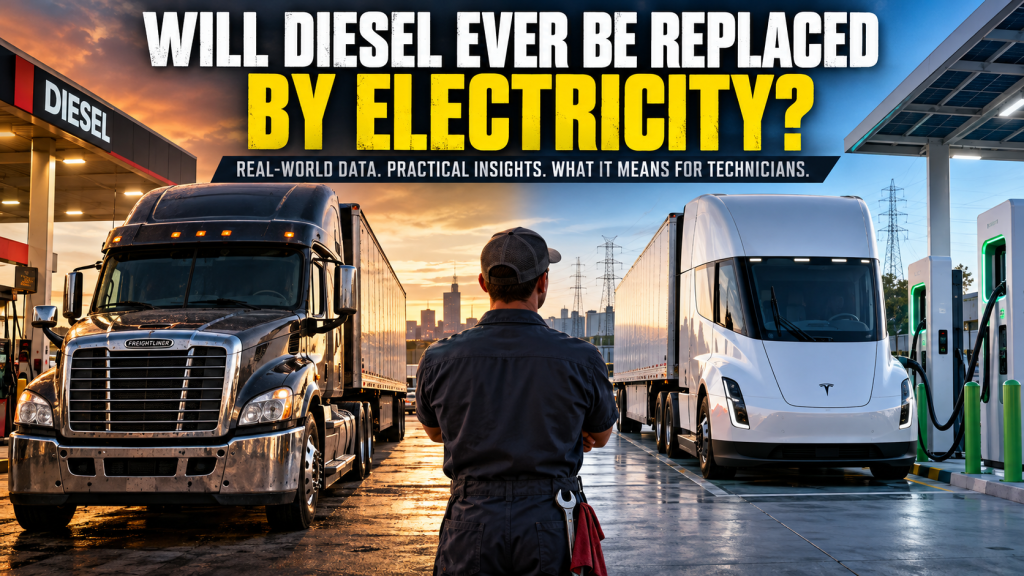
But the industry is changing. Electric trucks are no longer show pieces at trade expos. Manufacturers are building battery-electric Class 8 trucks, companies are investing in charging depots, and governments around the world are pushing fleets away from petroleum. That raises a fair question: will electricity eventually replace diesel?
The answer is more complicated than either side of the debate usually admits. I worked as a diesel mechanic in the U.S. Army, taught diesel technology, and now work in technical education, and I’ve watched this industry move from mostly mechanical systems to heavily electronic equipment. My view is that electric trucks are viable technology, but widespread adoption depends on two things more than the trucks themselves: electrical infrastructure and workforce development. Instead of diesel disappearing overnight, expect a long transition where diesel and electric equipment work side by side.
Here’s why.
Electric trucks are already a reality
The old argument that nobody can build an electric truck capable of real commercial work doesn’t hold up anymore. They already have. Two American examples show where the technology stands: Freightliner’s eCascadia and the Tesla Semi.
Freightliner eCascadia
The eCascadia is a battery-electric Class 8 tractor built on the same platform as the diesel Cascadia, one of the best-selling Class 8 trucks in North America. According to Freightliner’s spec sheet, it offers typical ranges of about 155, 220 or 230 miles depending on battery and axle configuration, and up to 470 horsepower.
Freightliner advertises a 0 to 80% charge in about 90 minutes on a high-power charger. On a lower-power 200-amp connection, that stretches to roughly 3 to 5 hours. Freightliner positions it for local and regional distribution, drayage and warehouse-to-warehouse work, the kind of fleets that come back to the same yard at the end of every shift.
Tesla Semi
Tesla is aiming at heavier, longer routes. Tesla lists two versions of the Semi: a Standard Range at an estimated 325 miles and a Long Range at an estimated 500 miles, both rated for 82,000 pounds gross combination weight. Tesla estimates energy use at about 1.7 kWh per mile and says its Megacharger, at up to 1.2 megawatts, can restore up to 60% of range in 30 minutes. The first Semi rolled off Tesla’s high-volume production line in Nevada in spring 2026.
Those range numbers come with fine print. Tesla bases them on a loaded truck at 55 mph on flat ground at about 68°F with an aero kit and a dry van trailer. Real routes have hills, cold mornings and less-than-perfect trailers.
A capable electric truck also doesn’t automatically make it the right truck for every job. Range, payload, charging access, utilization and total operating cost all decide whether it makes sense for a particular fleet.
My take: Manufacturers have largely answered whether a viable electric heavy-duty truck can be built. The bigger question now is whether the infrastructure and the economics can support them across the wider trucking industry.
How fast are electric trucks replacing diesel in the U.S.?
It’s important to separate what’s happening worldwide from what’s happening here.
Globally, electric truck sales are growing fast, mostly in China. According to the International Energy Agency’s Global EV Outlook 2026, electric trucks made up about 9% of truck sales worldwide in 2025, and roughly one in four trucks sold in China was electric.
The United States looks very different. According to the International Council on Clean Transportation (ICCT), the U.S. registered 460,299 new medium- and heavy-duty trucks and buses in 2025. Only 2,375 were zero-emission, about 0.52% of new registrations.
| Vehicle category | Zero-emission registrations | Share of segment |
|---|---|---|
| Medium-duty trucks | 603 | 0.33% |
| Heavy-duty trucks | 875 | 0.34% |
| Buses | 897 | 4.4% |
| Total | 2,375 | 0.52% |
The ICCT also reported that zero-emission registrations fell about 15.5% from 2024. Those numbers need some context. They include zero-emission technologies beyond battery-electric, they count new registrations rather than every truck on the road, and one bad year doesn’t make a permanent trend.
Still, the picture is clear: replacing America’s diesel fleet is a huge undertaking. Even if electric trucks grab a much bigger share of new sales in the future, millions of diesel trucks and machines already in service will need maintenance for years.
The electrical grid may be the biggest challenge
Building electric trucks is one thing. Building the infrastructure to run thousands of them is another.
Diesel trucks benefit from a fueling network built over many decades. Truck stops, fleet fuel islands and distributors let operators refuel quickly almost anywhere in the country. For electric trucks to compete across the same range of work, the industry needs dependable, high-capacity charging, and charging a Class 8 truck is not like charging a car. A heavy truck can need hundreds of kilowatt-hours to refill its battery. When a whole fleet plugs in at once, the demand adds up fast.
Consider a fleet of 50 electric trucks
Say a distribution center runs 50 electric trucks, and each one needs 500 kWh before its next shift. That fleet needs:
- 25,000 kWh of electricity for one charging session.
- An average load of 5 megawatts if that energy is delivered over five hours.
- Extra capacity on top of that for charging losses and the rest of the building.
Five megawatts is a serious load for one facility. To put it another way, a single Tesla Megacharger is rated at up to 1.2 megawatts, so just four trucks fast-charging at the same time draw about as much as that whole 50-truck overnight session. Supporting that kind of demand can mean new transformers, service upgrades, months of coordination with the utility and major distribution work. Multiply that by every terminal, port, warehouse and highway charging stop in a region and the scale of the job becomes clear.
Can the grid support it?
There isn’t a simple nationwide yes or no. The U.S. may be able to generate enough electricity for a lot of transportation electrification over time, but that doesn’t mean every truck yard has the power it needs today. Local distribution capacity matters. A utility may have to upgrade substations, feeders, transformers or transmission lines before it can serve a large charging depot, and those projects take time and money.
The challenge isn’t just producing enough electricity. It’s delivering it to the right places, at the right times, at a price that makes business sense.
Companies are already working on it
Companies like Zeem Solutions are building shared charging depots for commercial fleets, including a large site near LAX and one near SeaTac here in the Pacific Northwest. Fleets can charge there without building their own facility. That’s exactly the kind of groundwork the industry needs.
The bigger question is whether commercial charging can ever be as easy and dependable as diesel fueling is today. Not every electric truck needs public highway charging. Many regional fleets can run on overnight depot charging. Long haul is different. A truck crossing several states needs reliable charging sites that can fit a tractor-trailer and deliver enough power without long downtime. In my opinion, electrical infrastructure remains the biggest potential bottleneck to electrifying heavy trucks.
The economics depend on the job
One of the strongest arguments for electric trucks is lower operating cost. Diesel prices follow global oil markets, and a price spike can wipe out a fleet’s margins quickly. Electric trucks reduce that exposure. They also eliminate some diesel maintenance: oil changes, fuel system work and aftertreatment repairs like DPF and SCR problems.
But they bring their own costs: a higher purchase price, charging infrastructure, utility demand charges, financing and specialized maintenance. The right comparison isn’t the price of diesel versus the price of electricity. It’s total cost of ownership: purchase price, energy, maintenance, infrastructure, downtime, financing, utilization and resale value.
An electric truck on a predictable regional route may come out ahead. A truck running irregular routes through remote country may not. For a fleet, the best technology is the one that reliably does the work at a cost that pencils out.
Diesel and electric may coexist for decades
Think about how VHS gave way to DVD. VHS players didn’t vanish the day DVDs showed up. For years, stores sold combination VHS/DVD players because people still owned tapes while they slowly switched over.
Heavy-duty transportation could follow a similar path. Fleets have invested heavily in diesel trucks, fuel systems, shops, diagnostic tools and technician training, and those investments don’t disappear because a new option exists. Diesel also still fits work where energy density, long operating hours, remote fueling and high utilization matter most. Meanwhile, electric trucks will keep getting more attractive for predictable routes with dedicated charging.
Unlike VHS and DVD, though, diesel and electric don’t serve exactly the same needs. That difference could stretch the period of coexistence out even longer.
The truck shop of the future
Many shops will eventually need to support more than one kind of powertrain. Picture a diesel Freightliner in one bay getting fuel injection diagnostics, an electric truck in the next bay getting high-voltage diagnostics, and a third truck in for brakes, steering or suspension work that both technologies share.
That’s the reality for technicians. Even when the powertrain changes, most of the truck doesn’t. Electric trucks still have brakes, suspensions, steering, wheel bearings, cooling systems, electrical controls and plenty of mechanical parts that wear out. The profession isn’t disappearing. It’s evolving.
Workforce development may be the second-biggest bottleneck
As someone who has taught diesel technology and now works in technical education, this is one of my biggest concerns. Manufacturers can roll out new electric trucks, but somebody has to inspect, diagnose and repair them, and heavy-duty EVs bring new safety and technical demands. Technicians will need to understand:
- High-voltage safety and isolation procedures
- Battery management systems
- Electric traction motors and drive systems
- Inverters and power electronics
- High-voltage charging systems
- Thermal management
- Advanced electrical diagnostics and manufacturer-specific software
You can’t teach that in a one-hour classroom presentation. Training programs need the right equipment, qualified instructors, technical documentation and hands-on time with real systems.
Diesel programs are the natural starting point
Existing diesel technology programs are the most logical foundation for heavy-duty EV training. They already teach the mechanical systems on commercial vehicles, and most already cover electrical systems, electronic controls, diagnostic tools and troubleshooting. Adding electric propulsion to those programs makes more sense than building separate programs that duplicate most of the same curriculum.
Manufacturers and colleges have to work together
Colleges can’t do this alone. Manufacturers will need to partner with technical colleges and training organizations, and that means more than donating a truck. Real partnerships include access to service information, diagnostic software, instructor training, high-voltage safety resources and real work experience for students.
Money is a big part of this. Heavy-duty EVs and the training equipment that goes with them are expensive, and many programs already struggle to keep their diesel equipment current. Adding high-voltage systems without dedicated funding and technical support puts even more pressure on programs that are stretched thin.
That’s why I rank workforce development as the second-biggest bottleneck, right behind infrastructure. If the industry can’t train enough qualified technicians, fleets will struggle to keep increasingly complex trucks on the road. And if schools can’t get the equipment to train on, the skills gap only gets harder to close.
What this means if you’re thinking about a diesel career
I wouldn’t talk anyone out of diesel technology because electric trucks are getting more common. This may actually be a great time to get into the trade. The industry will keep needing technicians who understand mechanical systems, electrical diagnostics, hydraulics, brakes, suspension and vehicle electronics, and those fundamentals carry over no matter what’s turning the wheels.
If you’re starting out, get really strong at electrical and electronic systems. Modern diesels already depend on sensors, control modules, data networks and computer diagnostics, and learning those systems now builds the foundation for whatever comes next. It’s also exactly what the ASE T6 Electrical/Electronic Systems test covers, so it’s a good place to prove those skills.
One important caution: high-voltage EV work requires its own specialized training. Experience with 12- and 24-volt truck electrical systems alone doesn’t qualify anyone to work safely on a high-voltage propulsion system.
The technician of the future may be defined less by the kind of engine they work on and more by their ability to diagnose and maintain complex commercial vehicles.
Will electricity replace diesel completely?
Electricity will keep replacing diesel in some jobs. Regional delivery, transit, port equipment and predictable routes are the strongest opportunities. I’m much less convinced diesel will disappear from every heavy-duty application anytime soon. Long-haul freight, remote construction, agriculture, emergency power and other demanding work present very different challenges.
Battery technology, charging, electricity prices and vehicle economics will keep changing, and future improvements could make electric equipment competitive where it struggles today. At the same time, diesel isn’t standing still. Manufacturers keep improving efficiency, emissions controls and compatibility with renewable and alternative liquid fuels. The future will probably look like several technologies serving different jobs, not one powertrain replacing all the others.
My bottom line
American manufacturers have already shown that viable electric heavy-duty trucks can be built. The bigger questions are about the infrastructure and the workforce to support them:
- Can the grid deliver enough power to commercial charging sites?
- Can charging networks be as reliable and available as fleets need?
- Can technical colleges and manufacturers train enough qualified technicians?
- Can electric trucks pencil out across a wide range of commercial work?
Until those questions are answered at scale, expect diesel and electric trucks to work side by side. For repair shops, that means getting ready to service both. For training programs, it means strengthening electrical instruction while keeping the mechanical fundamentals that every truck still needs. And for technicians, it means a career that will cover a wider range of technology than ever before.
The future of diesel may not be diesel versus electricity. It may be about how the industry learns to support both.
Getting ready for your ASE certifications? Start with our ASE T2 Diesel Engines study guide or try 5 free practice questions with instant explanations.
Sources and further reading
- International Council on Clean Transportation, Race to Zero: Zero-Emission Bus and Truck Market in the United States, January–December 2025
- International Energy Agency, Global EV Outlook 2026
- Freightliner, eCascadia Specifications (FTL/MC-F-1667, May 2024)
- Tesla, Semi (specifications accessed October 2026)
- Automotive World, Long-awaited Tesla Semi enters volume production in Nevada
- CCJ, Zeem Solutions opening new EV charging facility near SeaTac Airport
- Margo T. Oge, Forbes, The Only Real Hedge Against Diesel Shock Is an Electric Truck, October 1, 2026
Editor’s note: Market figures reflect information available as of October 2026. Manufacturer specifications are as published by each manufacturer. Electric truck adoption, specs and infrastructure are changing quickly, and the author’s opinions are kept separate from the research and manufacturer information cited above.