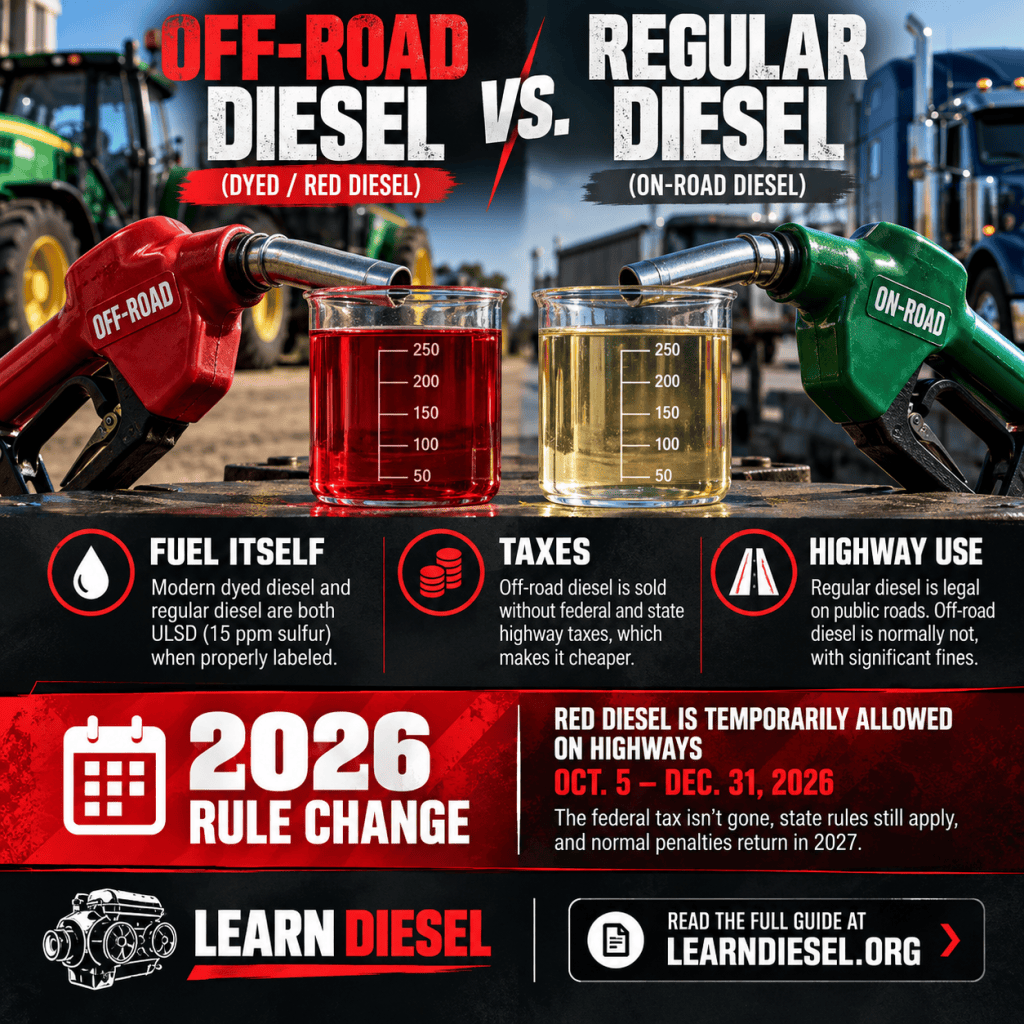
Pull into any farm supply or construction yard and you’ll see a pump marked “off-road diesel.” It’s cheaper than the fuel at the truck stop, and it’s red. So what is it, can it hurt a modern diesel, and why can it cost you a lot more than you saved?
News: red diesel is temporarily allowed on highways (through Dec. 31, 2026)
On October 5, 2026, President Trump signed an executive order titled “Emergency Tax Relief on Diesel Fuel.” From October 5 through December 31, 2026, it temporarily allows red-dyed diesel to be sold for and used in highway vehicles, including diesel pickups and commercial trucks, and it directs the IRS not to charge the usual dyed-fuel penalties during that window.
Before you fill up a highway truck with red fuel, know the fine print:
- The federal tax isn’t gone. The 24.4-cent-per-gallon federal diesel tax wasn’t repealed. As of early October, Treasury was still deciding whether it can be deferred, meaning paid later, or eliminated. Watch for IRS guidance, and keep your fuel receipts.
- State rules still apply. The order doesn’t override state fuel taxes or state dyed-fuel laws. It only encourages states to follow. Check your state before using dyed fuel on the road.
- Sulfur limits still matter. In past emergency waivers, the IRS still barred fuel above the allowed sulfur content from highway use. Only use dyed fuel labeled ULSD, 15 ppm, and never heating oil.
- It’s temporary. Unless something changes, the normal rules and penalties come back on January 1, 2027.
- Savings are modest. The federal tax works out to about $7 on a 30-gallon fill and about $60 on a 250-gallon fill.
Check your state first
The federal order only covers federal penalties and the federal tax. Every state sets its own fuel taxes and dyed-diesel rules, and red diesel is only legal on a state’s roads if that state allows it. Some states have said yes, some haven’t, and the rules are changing quickly.
OTR truckers, take note: even if your home state allows dyed diesel, you can still be fined the moment you cross into a state where it’s against the law. Roadside and weigh-station inspectors can test your tank, and red dye can stay detectable long after you’ve switched back to clear fuel. Check the rules for every state on your route before you fill up with red.
How to check
- Your state’s fuel tax agency. Usually the Department of Revenue or Department of Licensing. Look for a notice about dyed diesel.
- Your governor’s office. States that allow it are doing so through emergency declarations or executive orders.
- Your state Farm Bureau or trucking association. They track the rules closely and post plain-language updates.
If you can’t find a clear, written waiver for a state, assume the normal rules and penalties still apply there.
We’ll update this article as the IRS and states issue guidance.
What off-road diesel is
Off-road diesel, also called dyed diesel or red diesel, is diesel fuel sold for use in equipment that doesn’t run on public roads: tractors, excavators, loaders, generators, forklifts and other off-highway machines.
The big difference is taxes. Fuel used on public highways carries federal and state road taxes that pay for the roads. Off-road fuel is sold without those highway taxes, so it costs less. To make sure it isn’t used on the road, it’s dyed red so inspectors can spot it.
Is it a different fuel?
For most modern dyed diesel, the fuel itself is basically the same as road diesel. Under EPA rules, all nonroad, locomotive and marine diesel has had to be Ultra Low Sulfur Diesel (ULSD, 15 parts per million sulfur) since 2014, the same sulfur limit highway diesel reached in 2010.
| On-road diesel | Off-road (dyed) diesel | |
|---|---|---|
| Color | Clear to light amber | Red dye |
| Sulfur (modern fuel) | 15 ppm max (ULSD) | 15 ppm max (ULSD) for nonroad fuel |
| Highway fuel taxes | Included | Not included |
| Legal for highway vehicles | Yes | No |
There’s one important catch: not every red fuel is ULSD. Heating oil is also dyed and isn’t covered by the ULSD rules, so it can carry much more sulfur. Always read the pump or the delivery ticket. If it doesn’t say “Ultra Low Sulfur Diesel, 15 ppm,” don’t put it in a modern engine.
What it means for modern emissions systems
Today’s diesels, including 2007 and newer on-road engines and Tier 4 Final off-road equipment, depend on aftertreatment that only works with ULSD:
- Diesel oxidation catalyst (DOC): burns off hydrocarbons and helps heat the exhaust for DPF regeneration.
- Diesel particulate filter (DPF): traps soot and burns it off during regeneration.
- Selective catalytic reduction (SCR): uses DEF to turn NOx into nitrogen and water.
Dyed ULSD won’t hurt these systems. The red dye has no effect on the engine or aftertreatment, and the fuel meets the same 15 ppm sulfur limit.
Higher-sulfur fuel will. Running heating oil or older 500 ppm fuel in an engine built for ULSD can:
- Poison the DOC and SCR catalysts so they stop working
- Load the DPF with sulfates and ash, causing more frequent regens, high back pressure and derates
- Set emissions fault codes and lead to expensive aftertreatment repairs
- Void the engine and emissions warranty
The normal rules: fines for highway use
Outside the temporary window above, running dyed fuel in a vehicle on public roads is illegal, and the problem isn’t mechanical, it’s legal. The IRS and state agencies check fuel tanks at roadside inspections, weigh stations and fuel terminals, and they can detect even a small amount of dye.
- Federal penalty: $10 per gallon or $1,000, whichever is greater, for each violation.
- Repeat violations: the $1,000 minimum goes up by $1,000 for every prior penalty.
- State penalties: many states add their own fines on top.
Dye also lingers. Topping off a tank of dyed fuel with road diesel won’t make it pass a test, so a truck can get fined weeks after the dyed fuel went in.
Tips for techs and operators
- Check the label every time. Look for “ULSD, 15 ppm” on dyed fuel used in Tier 4 equipment.
- Never use heating oil in engines with a DPF or SCR system.
- Keep off-road and on-road fuel separate in shop tanks and fuel cans.
- If a highway truck shows red fuel in the filter or water separator, tell the owner. It’s a tax problem, not a repair, but it can cost them thousands.
- Keep fuel receipts. They prove what went into equipment if there’s ever a question.
The bottom line
Modern off-road diesel is the same clean ULSD as road fuel, just dyed and sold without highway taxes. It’s safe for modern emissions systems when it’s labeled 15 ppm ULSD, and outside the temporary 2026 waiver it’s illegal in highway vehicles, with fines that add up fast. Even during the waiver, check your state’s rules and plan for the federal tax possibly coming due later. The fuel to really watch out for is high-sulfur heating oil, which can wreck a DPF and SCR system.
Studying for your ASE T2? Fuel quality and emissions systems are on the test. Read our ASE T2 Diesel Engines study guide, then try 5 free practice questions.

