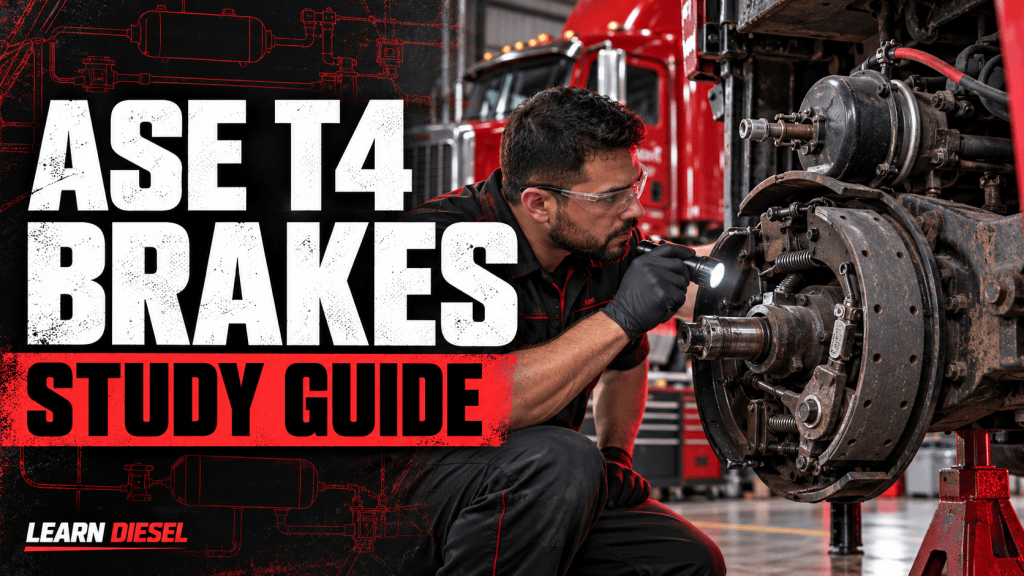
The ASE T4 Brakes test is where heavy-duty techs prove they can keep an 80,000-pound truck stopping safely. Air brakes make up most of the test, so if you can diagnose an air system from the compressor to the slack adjuster, you’re most of the way there.
This guide covers what’s on the T4, where the points are, the concepts that show up again and again, and a simple plan to get ready.
The T4 test at a glance
The T4 has about 50 scored questions, plus around 10 unscored research questions mixed in. You won’t know which ones don’t count, so treat every question like it does. You get about 75 minutes.
| Content area | Scored questions |
|---|---|
| A. Air Brakes | About 32 |
| B. Hydraulic Brakes | About 11 |
| C. ABS, Traction Control, Stability Control and Collision Warning | About 7 |
| Total | About 50 |
To earn the certification, you also need two years of hands-on work experience. A diesel or heavy-equipment program can count for up to one of those years. Registration is $34 per order plus $62 per test.
A. Air Brakes (about 32 questions)
This is almost two-thirds of the test. Know the whole system: how air is made, stored, delivered and released.
Air supply
- Compressor and governor: the governor tells the compressor when to pump (cut-in) and when to stop (cut-out). Typical cut-out is around 120 to 135 psi. Know how to diagnose a governor that won’t cut out versus a compressor that can’t keep up.
- Air dryer: removes moisture and oil before air reaches the tanks. A dryer that never purges, or tanks full of water, point to dryer or purge-valve problems. Oil in the tanks usually points back to the compressor.
- Reservoirs: supply (wet), primary and secondary tanks. Know the check valves that keep one circuit from draining the other.
- Leak-down and build-up tests: know how to run a static and an applied leak test and what pressure drop per minute is acceptable, plus build-up time and low-air warning operation.
Service, parking and emergency brakes
- Valves: foot (treadle) valve, relay valve, quick-release valve, spring brake control valve and tractor protection valve. Questions often ask which valve causes a slow apply or slow release on one axle.
- Spring brakes: held off by air, applied by spring force. Know how to cage a spring brake safely before working on it.
- Tractor protection: know what happens to the trailer supply line when tractor air pressure drops.
Foundation brakes
- S-cam drum brakes: camshaft bushings, rollers, return springs and shoe wear. Know drum discard dimensions (stamped on the drum) and how to measure them.
- Automatic slack adjusters: check pushrod stroke at a full application. An out-of-adjustment automatic slack means something is wrong with the slack or the foundation brake. Don’t just keep adjusting it by hand.
- Air disc brakes: pad wear, rotor cracks and caliper slide function.
B. Hydraulic Brakes (about 11 questions)
Medium-duty trucks, buses and many vocational units still use hydraulic brakes, often with a hydraulic power assist.
- Master cylinder and lines: spongy pedal versus pedal that sinks slowly. Air in the system versus internal master cylinder leakage.
- Power assist: vacuum boosters and hydraulic boosters (powered by the power steering pump), plus the electric backup pump many systems use.
- Bleeding: correct sequence and when a scan tool is needed to bleed an ABS unit.
- Disc and drum service: rotor thickness, runout and parallelism, and caliper slide problems that cause uneven pad wear.
C. ABS, Traction Control, Stability Control and Collision Warning (about 7 questions)
- Wheel speed sensors: air gap, resistance checks and AC voltage output while spinning the wheel. A loose sensor or excessive bearing end play can set codes.
- Modulator valves: how they hold or release air at a wheel, and how to test them.
- Codes: reading blink codes and using a scan tool. Know which faults put the ABS lamp on.
- Stability control and collision mitigation: steering angle and yaw sensors, and radar or camera alignment after a front-end repair or bumper replacement.
Try a few practice questions
Question 1
An air brake system takes too long to build pressure from 85 to 100 psi. Technician A says a leaking reservoir drain valve could cause this. Technician B says a worn compressor could cause this. Who is right?
- A. Technician A only
- B. Technician B only
- C. Both A and B
- D. Neither A nor B
Answer: C. Both A and B. Any leak or a compressor that can’t pump enough air will slow build-up. Do a leak test first, then check compressor output.
Question 2
A truck with automatic slack adjusters has one brake with excessive pushrod stroke. What should the technician do first?
- A. Manually adjust the slack and release the truck
- B. Replace all slack adjusters on the axle
- C. Inspect the foundation brake and the slack adjuster for the cause
- D. Increase governor cut-out pressure
Answer: C. An automatic slack that’s out of adjustment is a symptom. Find the cause, such as worn cam bushings or a failed slack, before returning the truck to service.
Question 3
An ABS wheel speed sensor reads correct resistance, but the ABS sets a fault for that wheel at road speed. Which is the most likely cause?
- A. Excessive sensor air gap
- B. Low battery voltage
- C. Wrong brake fluid
- D. Weak spring brake
Answer: A. If the sensor has pushed back away from the tone ring, its signal is too weak at speed even though resistance tests fine. Push the sensor back in and check wheel bearing end play.
A simple 4-week study plan
- Week 1, air supply: compressor, governor, dryer, reservoirs and leak tests. This is the biggest piece of the test.
- Week 2, valves and foundation brakes: trace air through each valve on a system diagram, then study slack adjusters, S-cams and air disc brakes.
- Week 3, hydraulic brakes and ABS: master cylinders, boosters, bleeding, wheel speed sensors and modulators.
- Week 4, practice and review: take timed practice tests, then go back over every question you missed.
Keep going with the ASE T-Series
Working on your full Medium/Heavy Truck certification? Start with our ASE T2 Diesel Engines study guide, then take a free practice test with instant explanations for every answer. T4 Brakes practice tests are coming next.



Leave a comment