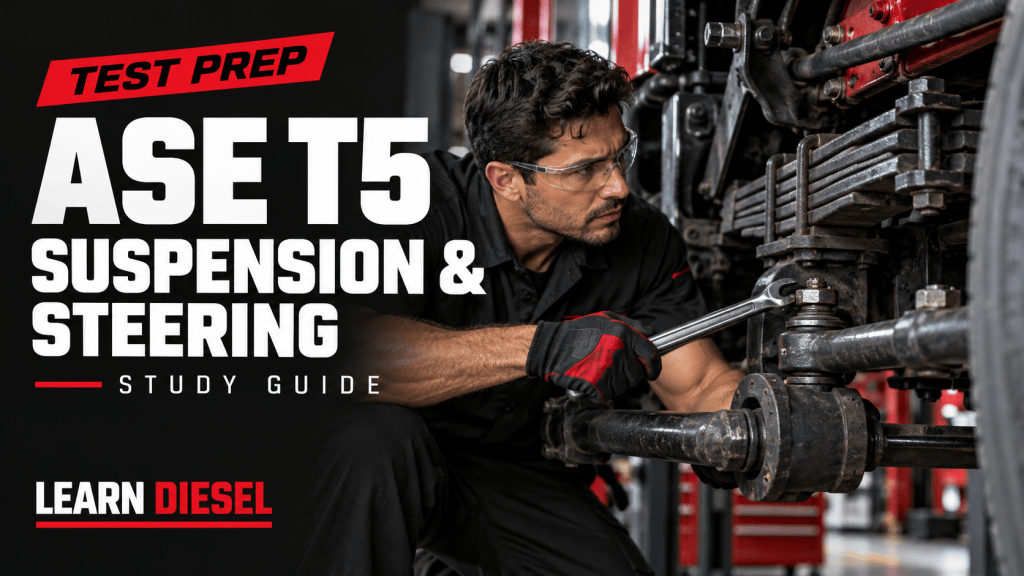
The ASE T5 Suspension and Steering test covers everything that holds a medium or heavy truck up and points it down the road. That means steering gears and linkage, springs and air ride, frames and fifth wheels, alignment angles, and the wheel ends that tie it all together. If you’ve chased a pull, a wander or a chewed-up set of steer tires, you’ve already done T5 work.
This guide walks through what’s on the test, how the questions break down, and the shop knowledge you need for each area. At the end you’ll find practice questions and a simple study plan.
The T5 test at a glance
The T5 has about 50 scored questions, plus around 10 unscored research questions mixed in. You won’t know which ones don’t count, so treat every question like it does. Plan on about 75 minutes of testing time.
| Content area | Scored questions |
|---|---|
| A. Steering System Diagnosis and Repair | About 12 |
| B. Suspension, Frame, and 5th Wheel Diagnosis and Repair | About 16 |
| C. Wheel Alignment Diagnosis, Adjustment, and Repair | About 13 |
| D. Wheels, Tires and Hub Diagnosis and Repair | About 9 |
| Total | About 50 |
To earn the certification, you also need two years of hands-on work experience. A diesel or heavy-equipment program can count for up to one of those years. Registration is $34 per order plus $62 per test.
A. Steering System Diagnosis and Repair (about 12 questions)
This section is about the path from the steering wheel to the steer tires. Expect questions on hard steering, free play, noise and fluid problems, and how to prove whether the pump, the gear or the linkage is at fault.
Power steering hydraulics
- Flow and pressure testing: Install the analyzer between the pump and gear. With the load valve open you read flow and system pressure. Briefly closing the valve (no more than about 5 seconds) shows the pump’s maximum relief pressure. Low pressure with the valve closed means a pump or relief valve problem.
- Fluid: Foamy fluid means air is getting in, usually from a low level or a leak on the suction side. Dark, burnt-smelling fluid points to overheating.
- Coolers and hoses: A plugged cooler or a kinked or collapsed hose raises fluid temperature and can cause poor assist. After a pump or gear failure, flush the system and cooler so debris doesn’t kill the new part.
- Poppets and wheel stops: Poppet (unloading) valves in the gear drop pressure just before the axle stops make contact. If the stops are changed, the poppets must be reset. Poppets that don’t unload leave the pump at relief at full lock, which overheats the fluid and loads up the linkage.
Columns, gears and linkage
- Free play: Work from the wheel down. Check column U-joints, pinch bolts and intermediate shaft splines, then the gear mounting and sector shaft, then the linkage.
- Drag link and tie rods: A dry park check, engine running with the tires on the ground, is the best way to find worn sockets. Any lost motion at a joint is a problem. The drag link centers the gear and steering wheel; the cross tube sets toe.
- SRS: Disconnect the battery and wait the specified time before unplugging an airbag. Carry the module with the trim facing away from you and set it face up.
B. Suspension, Frame, and 5th Wheel (about 16 questions)
This is the biggest section on the test. It covers the steer axle, every common rear suspension type, the frame, and the coupling devices.
- Kingpins: Check bushing wear with the axle raised and the tire off the ground, using a dial indicator on the knuckle. Excessive vertical play between the knuckle and axle beam points to a worn thrust bearing or the need for shims.
- Shocks: A good shock is warm after a road test. Light misting is normal; a wet, dripping shock needs replacement.
- Leaf springs and U-bolts: The center bolt locates the axle on the spring pack. A sheared center bolt lets the axle shift and the truck dog tracks. Tighten U-bolts in stages in a crisscross pattern with the weight on the springs, and retorque after break-in.
- Torque rods and walking beams: Torque rods keep axles square and control windup. Worn bushings cause misalignment, driveline vibration and tire wear. Worn walking beam center or end bushings cause the same kind of tracking and wear problems.
- Air suspension: The height control valve adds air when the frame drops and exhausts air when it rises. A built-in time delay keeps it from reacting to every bump. Set ride height on level ground with full system air, measured at the points the manufacturer specifies. Wrong ride height upsets driveline angles and causes vibration.
- Frames: Inspect for cracks, especially near crossmembers, spring hangers and holes. Drill only in the web, never the flanges, and don’t torch-cut holes. Many frames are heat-treated, so follow the OEM’s repair procedure before you weld anything.
- Fifth wheels and pintle hooks: A clunk on starts and stops usually means excess slack between the locking jaws and kingpin. Check and adjust the lock per the manufacturer. On pintle hooks, check the hook and latch for wear and make sure the latch locks.
C. Wheel Alignment (about 13 questions)
Alignment questions usually start with a complaint: a pull, wander, off-center steering wheel or tire wear. Your job is to match the symptom to the angle. Always inspect for worn parts and check ride height before you align anything.
- Camber: Too much positive camber wears the outside shoulder; too much negative wears the inside. On most I-beam steer axles camber isn’t adjustable in normal service, so a bad reading usually means a bent part or worn kingpins.
- Caster: Positive caster gives directional stability and return to center. A truck pulls toward the side with less positive caster. Caster is changed with tapered shims between the spring and axle.
- Toe: Toe is the biggest tire wear angle. It’s set by turning the cross tube. Too much toe-in or toe-out scrubs the tires and leaves feathered edges.
- Thrust angle and rear axle alignment: If the drive axles aren’t square to the frame centerline, the truck crabs and the steering wheel sits off center. On tandems, both axles also need to be parallel to each other. Align the rear first, then set front toe.
- Turning angles: The inside wheel turns sharper than the outside wheel. If the angles are off, look for a bent steering arm or tie rod arm.
- Wheel bearing adjustment: The common industry procedure for adjustable wheel ends targets 0.001 to 0.005 inch of end play, measured with a dial indicator.
- Steering angle sensor: On trucks with stability control, calibrate the sensor after an alignment or any steering gear, column or linkage work.
D. Wheels, Tires and Hub (about 9 questions)
This section is about reading tires and getting wheel ends right.
- Hub-piloted vs. stud-piloted: Hub-piloted wheels center on pilot pads on the hub and use two-piece flange nuts. Stud-piloted wheels center on ball seat nuts. Never mix parts between the two systems. Tighten in a star pattern to the specified torque and recheck after the first miles.
- Tire wear patterns: Shoulder wear points to camber or inflation, feathering points to toe, and cupping points to weak shocks, imbalance or loose bearings.
- Runout and balance: Check the hub and wheel first. If they’re in spec, match mount the tire to line up high and low spots. Balancing doesn’t fix runout.
- Hubs and bearings: Unitized or preset hubs aren’t adjusted. You torque the spindle nut to spec and lock it.
- Tire inspection and TPMS: Look for cuts, bulges, exposed cords, mismatched duals and low tread depth. TPMS sensors report pressure and often temperature; handle them carefully when breaking down a tire.
Try a few practice questions
Question 1
A truck pulls to the right. Camber and toe are in spec. The left side has 4 degrees of positive caster and the right side has 2 degrees. What is the most likely cause?
- A. Excessive toe-in
- B. Worn rear torque rods
- C. The caster difference side to side
- D. Normal road crown
Answer: C. A truck pulls toward the side with less positive caster. A 2 degree split is far too much, so look for a bent axle, wrong shims or a shifted axle.
Question 2
What is the main job of the poppet valves in an integral power steering gear?
- A. To set maximum pump flow at idle
- B. To reduce hydraulic pressure as the wheels approach the axle stops
- C. To keep the steering wheel centered
- D. To bleed air out of the gear
Answer: B. Poppets unload pressure just before the stops make contact, so the pump isn’t stuck at relief at full lock.
Question 3
Technician A says hub-piloted wheels can go on a stud-piloted hub if the bolt circle matches. Technician B says mixing hub-piloted and stud-piloted parts can cause wheels to come loose. Who is right?
- A. Technician A only
- B. Technician B only
- C. Both A and B
- D. Neither A nor B
Answer: B. The two systems use different wheels, nuts and clamping methods. Mixing them gives poor clamp load, which leads to broken studs and lost wheels.
A simple 4-week study plan
- Week 1, steering: Study power steering flow and pressure testing, poppet adjustment, and the dry park check.
- Week 2, suspension and frame: Cover kingpins, leaf springs, torque rods, walking beams and air ride. Practice setting ride height and checking fifth wheel lock adjustment.
- Week 3, alignment: Learn what camber, caster, toe and thrust angle do and how each one shows up as a complaint. Review wheel bearing adjustment and steering angle sensor calibration.
- Week 4, wheels, tires and review: Study wheel mounting systems, torque, runout and tire wear patterns. Then take full practice tests and review every miss.
Keep going with the ASE T-Series
Working through the series? Check out the ASE T2 Diesel Engines study guide, or take a free practice test with instant explanations. T5 practice tests are coming soon.



Leave a Reply